
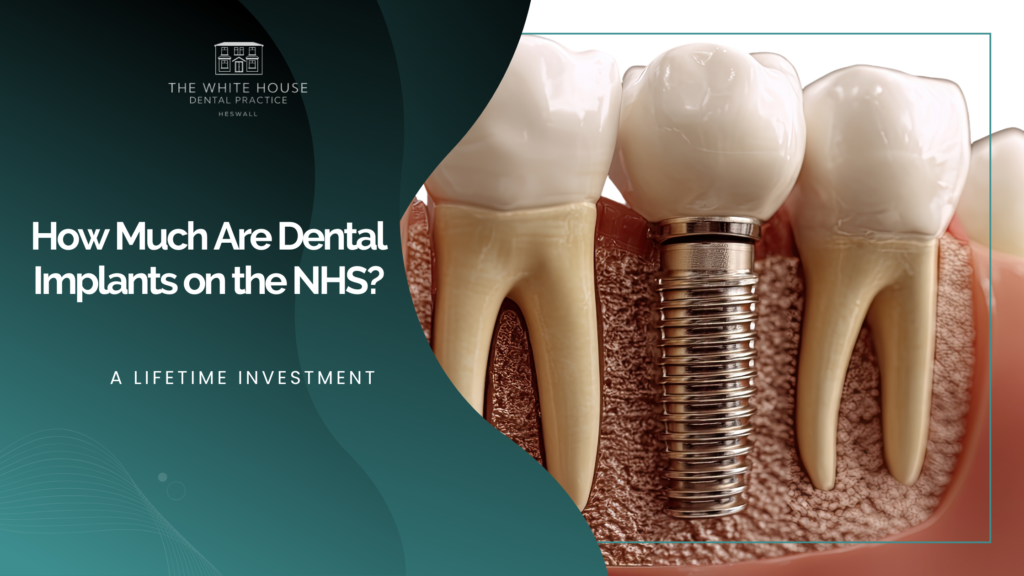
If you’re missing a tooth (or a few) and you’re picturing that gap every time you smile in the mirror, it’s completely normal to wonder: can I get dental implants on the NHS, and what will they cost? At The White House, we see how tooth loss can quietly chip away at confidence, from avoiding certain foods to laughing with your hand near your mouth.
Let’s make this simple and honest.
NHS availability: are dental implants funded?
Dental implants are very rarely available as NHS funded treatment. The NHS is clear that implants are usually only available privately, and that NHS provision tends to be limited to specific situations
In practice, NHS-funded implants are typically reserved for people with severe tooth loss linked to major medical or trauma-related needs, for example:
- Head and neck cancer and reconstruction after treatment
- Serious accidents or major facial trauma
- Certain congenital conditions where teeth are missing or cannot develop normally
It’s also worth knowing that NHS implant decisions are usually made within hospital services, rather than in routine NHS dental practice, and your NHS dentist may need to refer you for assessment.
If your tooth loss is linked to common issues like decay, gum disease, or a straightforward tooth removal, NHS implant access is unlikely. That can feel frustrating, especially when you’re already trying to protect your long-term dental health, but it helps to know the landscape before you book a dental appointment and pin your hopes on it.
NHS costs and tiers: what would you pay if you’re eligible?
In England, most NHS dental treatment sits within a banding system. Current charges (from 1 April 2025) are: Band 1 £27.40, Band 2 £75.30, Band 3 £326.70, and urgent or emergency dental care £27.40.
Implants are not routinely listed as a standard banded item because they’re so rarely provided, often through hospital pathways. But if you were charged under the NHS dental band system for advanced restorative work, the highest level of contribution is typically Band 3 (the band that covers complex lab work like crowns and dentures)
So, for the small number of people who meet the strict criteria and are accepted for NHS implant treatment, the out-of-pocket cost may be relatively low compared with private fees, but it depends on how and where the treatment is delivered.
Now, here’s the contrast.
Private costs: what do implants cost outside the NHS?
Private dentistry gives you far more availability and choice, including planning, materials, timelines, and the clinician’s experience. It also means you can move forward without waiting for rare approvals.
Our published fees show:
- Dental Implants, replace 1 tooth: £2,850
- Replace 2 teeth: £5,600
- Replace 3 teeth: £6,975
- Replace 4 teeth: £8,350
These figures are really helpful when you’re comparing options like dental bridges, dentures, or other alternative treatments. It’s a bit like choosing between a tailored suit and an off-the-rack one. Both can do the job, but the fit, feel, and long-term comfort can be very different.
Financial options: spreading the cost
Private treatment does not have to mean paying everything at once. Many patients choose to spread the cost over time, especially for larger plans.
Finance options can allow payments over 12 months and, in some cases, up to 60 months, which can make the cost of dental implants feel far more manageable as part of real life.
Are dental implants worth the money?
For many people, yes, dental implants can be worth it, especially if you want something that feels secure and natural.
Think about the sensory side of it. With a well-planned implant, you can bite into a crisp apple without that little wobble-fear that can come with dentures. You can chew on both sides again. You can speak without feeling like something might shift. That confidence can be priceless.
Implants can also support long-term dental health because they help reduce the “knock-on effect” of tooth loss, where neighbouring teeth drift and your bite changes over time.
What is the downside of teeth implants?
It’s only fair to talk about the downsides too.
- Cost: The upfront cost is higher than many other dental treatments, especially compared to dentures or some bridge options.
- Time: Implant treatment is a process, not a single visit. Healing and planning matter.
- Health factors: Conditions like uncontrolled gum disease can affect suitability, so stabilising your oral health first is essential.
- Not instant: Some people expect a “new tooth in a day” experience, but in many cases the safest route involves stages.
In other words, implants can be brilliant, but they’re not a magic wand. They’re more like renovating a house properly: the best results come from strong foundations, careful planning, and patience.
Single Tooth Implant Cost UK?
If you’re missing a single tooth, this is often the simplest implant scenario. At The White House, the fee to replace 1 tooth with a dental implant is £2,850.
People often compare this with dental bridges. A bridge can be a good solution for some, but it may involve preparing adjacent teeth, whereas an implant is designed to replace the missing tooth more independently.
What I wish I knew before dental implants?
Here are a few things many patients say they wish they had known earlier:
- The importance of a calm, unhurried consultation where everything is explained in plain English
- That dealing with gum disease first can be the difference between a smooth journey and frustration later
- That timelines vary, so it helps to plan around holidays, work events, and family moments
- That finance can make a big difference, whether that’s 12 months or longer terms like 60 months
Most of all, people often say they wish they had known they didn’t need to “put up with” missing teeth for years. If you currently wear dentures and you’ve adapted, it can still be worth exploring whether you have options that feel more like your own teeth again.
How much is a full set of dental implants?
A “full set” can mean different things. Some people mean replacing all teeth in one jaw, others mean replacing multiple missing teeth.
What we can say clearly from our fees is that multiple-tooth implant plans scale depending on how many teeth are being replaced, for example £8,350 to replace 4 teeth with implants.
For a true full-arch or full-mouth plan, the right cost can only be confirmed after an assessment because it depends on your bite, bone levels, health history, and what you want day-to-day (comfort, aesthetics, ease of cleaning, and more). That’s why a proper dental appointment and personalised plan matter so much.
If you’d like to talk about private dental implants, we’re here to help you feel calm and clear about the next step.
Because here’s the real question: if you could fast-forward a year and picture yourself smiling without thinking twice, what would it take to make that version of you feel real?