
Did you know that over 238,900 implant procedures were performed in the UK in the year 2022 alone? This shows how popular tooth implants are!. Today, they have become the most sought-after tooth replacement option in the UK. If you’re also thinking of getting your missing teeth replaced with dental implants, this guide is for you. In this blog, we will discuss the various benefits of dental implants so that you can decide whether they are a suitable treatment option for you.
So, read on till the end to learn more about tooth implants.
What Is A Dental Implant?
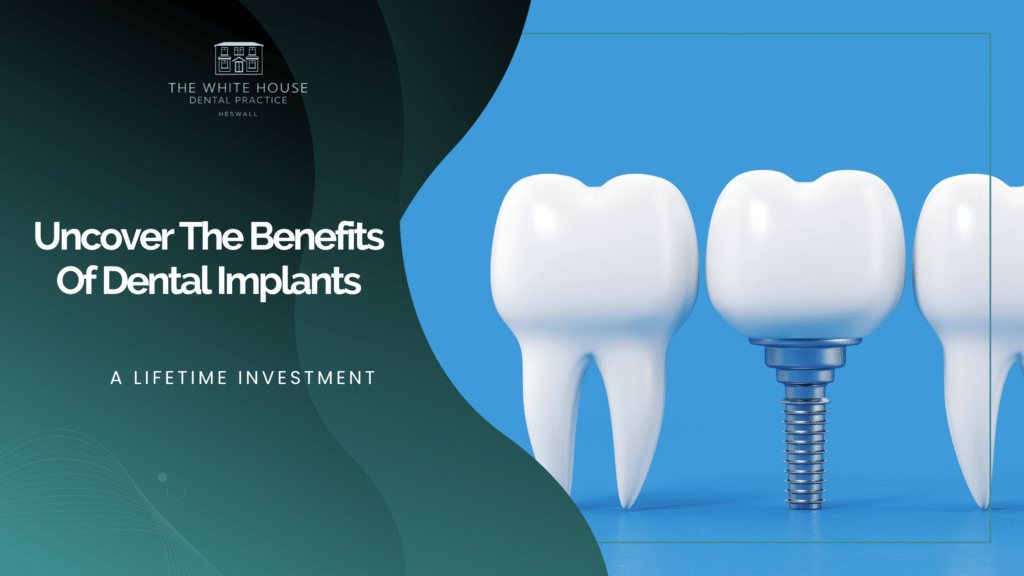
According to the Oral Health Foundation, a dental implant is a screw-shaped fixture made of titanium. Dental implants serve as replacement roots for artificial teeth and provide a solid foundation for the attachment of various tooth replacement prostheses such as crowns, dentures and bridges.
How Does A Dental Implant Work As A Tooth Replacement?
Dental implants are made of titanium. This material possesses are unique property, in which it promotes bone formation around it. So, once an implant is placed into the jawbone, new bone tissue begins to form around it. This way, the implant becomes firmly anchored and provides a solid foundation for any prosthesis attached to it. This process is known as osseointegration, and it forms the basis of the working of tooth implants.
Can You Get Dental Implants If You Don’t Have Any Teeth?
Yes, you can get dental implants even if you don’t have any teeth. For replacing a single missing tooth, your dentist will place a crown over the implant. In the case that someone is missing more than one tooth, they can get implant-supported bridges or overdentures for tooth replacement. Finally, if someone doesn’t have any teeth remaining, they should consider an all-on-4 implant-supported prosthesis.
The all-on-4 prosthesis utilises four implants in each jaw, which are placed at strategic locations. These four implants are then used to support a complete fixed bridge. Since this prosthesis uses four implants, it is named “all-on-4”.
Can Dental Implants Help Prevent Bone Loss In The Jaw?
A significant drawback of removable dentures is that they rest directly on the jawbone. This results in direct pressure on the jawbones, resulting in the degradation of the surrounding bone tissue. This is why denture wearers often require repairs or replacement, as their jawbone continues to degrade over time.
This problem has been overcome by dental implants. A unique feature of tooth implants is that they don’t cause any bone resorption. Instead, they promote new bone formation around them, which improves the implant’s stability. So yes, dental implants do help prevent bone loss in the jaws.
How Does Gum Disease Affect Dental Implants?
Have you ever wondered why dentists don’t recommend getting implants with underlying gum disease? This is because long-standing gum disease can cause significant damage to the jawbone. But an implant’s success is directly dependent on the availability of high-quality bone tissue to support it. Therefore, implant placement during gum disease may impact their clinical outcome and even lead to implant failure. This is why implant specialists treat underlying gum disease first and then proceed with tooth replacement.
What Is Bone Grafting In Dental Implant Treatment?
Bone grafting is a procedure in which bone tissue obtained from a human, animal, or artificial source is placed in the jaws to restore their quality. According to the Cambridge University Hospitals, a bone grafting procedure is a procedure in which your dentist adds additional bone tissue to your jaw to enhance the stability and anchorage of dental implants.
Not all dental implant patients require a bone graft. Only those patients who don’t have sufficient jawbone tissue available to support an implant need to undergo this procedure. A bone graft can be acquired from various sources. These include:
- The patient’s own bone tissue is extracted from another site in the body
- Another person’s bone tissue graft
- Bone tissue graft obtained from an animal source (bovine/ porcine)
- Bone grafts that are created artificially
Are Dental Implants Safe For My Long-Term Oral Health?
One of the reasons why tooth implants are so popular worldwide is their excellent safety and biocompatibility. Titanium-based implants don’t cause any adverse or allergic reactions in the body. Hence, they can be safely used for replacing missing teeth in the oral cavity.
Are Dental Implants As Strong As Real Teeth?
Dental implants are made of titanium, a material that is extremely strong and durable. Research shows that titanium implants rarely fail due to mechanical failure or fracture. In most cases, they can last for a lifetime if they are looked after properly.
Can Dental Implants Last A Lifetime?
Unlike other tooth replacement options, such as bridges and dentures, tooth implants can last a lifetime. However, this depends on whether the procedure is performed by an experienced and qualified dentist. More importantly, one must take good care of their implant-supported artificial teeth through regular brushing and flossing. So, if you’re looking for a permanent tooth replacement option that lasts a lifetime, you should consider dental implants.
If you’re searching for the best implant dentist in Meseyside, you should visit The White House Dental Practice. We take pride in having a highly qualified team of dentists with us who will take care of all your dental needs. Get in touch with us today and let us give you a healthy and confident smile with tooth implants.